

There are a good handful of electric sauna heater options out there. Wall mounted heaters, tower heaters, big baskets of rocks, small baskets of rocks, exposed elements, protected elements, Wi-Fi controls, and different shapes, sizes, and kilowatt ratings.
And increasingly, there is a lot of SEO optimization and social media marketing to sell you one.
But when we strip all this away, what are we really asking an electric sauna heater to do? Heat the rocks. Heat the room. Make good steam. And keep doing it reliably.
I’ve spent a lot of time around sauna heaters. I’ve been a wood fired aficionado for several decades. And I have been testing electric sauna heaters for years now. I have visited most all the major sauna heater factories. I’ve talked with manufacturers, builders, sauna operators, and people who live with these heaters every day. Through SaunaTimes, I could represent all the major brands. But I have a different path for your consideration.
The more I study electric sauna heaters, the more I keep coming back to a few basic principles. Let’s start there.
1. Size the heater to the room
Electric sauna heaters are sized by kilowatts. A 6 kW heater is intended for a smaller hot room than a 9 kW heater. Manufacturers publish cubic-foot ranges for their heaters, and these are a good starting point.
But sauna sizing isn’t just about measuring length × width × height. Glass, masonry, concrete, and other uninsulated surfaces create additional heat load. Ceiling height matters. Insulation matters. Indoor vs. outdoor is a key variable. And how the sauna is built matters.
We don’t want to undersize an electric heater. Nobody wants to wait forever for the sauna to heat. But here’s something that doesn’t get discussed enough. We don’t necessarily want to oversize it, either.
A substantially oversized heater can bring the air temperature up quickly. The thermostat reaches its set point and cycles the elements off. Great, the thermometer says 180°F. But are the rocks hot?
And that’s where we get into one of the most important concepts in electric sauna heater performance. For more please review my 2023 article, Goldilocks, the three bears, and sizing your electric sauna heater.
| Hot room | Cubic feet | Heater to consider |
|---|---|---|
| 5′ × 7′ × 7’6″ | 263 | 6 kW |
| 8′ × 8′ × 7’6″ | 480 | 9 kW |
| 8′ × 10′ × 7’6″ | 600 | 9–12 kW |
2. Hot air vs. hot rocks
A sauna heater has two jobs happening at the same time, heating the hot room and heating the rock mass. Air heats quickly. Rocks and mass take longer.
The Finnish word lämpömassa gets us thinking in the right direction, thermal mass. More hot mass generally means more stored energy. And more time allowed for the room and the rocks to get hot help us appreciate multidirectional hot room microclimate heat. Heat the room and heat the rocks.
A giant basket containing 200 pounds of lukewarm stones is arguably more wimpy than a heater with a smaller quantity of properly heated stones. We want the stones charged with heat so that when we throw water onto them, they have enough stored energy to vaporize that water effectively and deliver good löyly.
This is why simply saying, “My sauna gets to 180°F in 30 minutes,” doesn’t tell us everything we need to know. Think of sauna heating mechanism as a battery. A component of a complete system. What temperature are the rocks? How much heat energy is stored in them? And what happens after three or four ladles of water?
This is where recovery becomes important. After a good löyly blast, how quickly can the heater put energy back into the stones so we’re ready to go again?
For me, this is a much more useful way to evaluate a sauna heater than simply asking how fast the room heats up or how many pounds of rocks the heater holds. Air temperature matters. Rock mass matters. But hot rock mass and recovery are what help turn a hot room into a good sauna. For more on this, please check my 2023 article A lukewarm stone gathers no steam.

Deciding on an electric sauna heater? We have one for you. Factory direct to your front door. And we’ll help you size correctly. Fill out a request for quote here.
3. Exposed elements vs. protected elements
Look inside many traditional electric sauna heaters and you’ll see heating elements woven directly through the rocks. Packing stones in and around those elements becomes a time-consuming game of Tetris. This conventional design has worked for decades, but it comes with compromises.
Rocks settle, crack, and get moved around. Water travels through the rocks and contacts the elements directly. Every time we replace or rearrange stones, we’re working around relatively fragile heating elements. Elements can twist, short out, and eventually fail.
There’s another way to build an electric sauna heater: protect the elements.
Instead of packing rocks directly against the elements, the elements are separated from the rock chamber. The rocks aren’t pushing against them, yet heat still transfers effectively into and through the rock mass.
Do the rocks get as hot with protected elements? Absolutely. This requires a bit of a paradigm shift in how we think about heating sauna rocks. The rocks don’t need to sit directly against the heating elements to get hot. They heat through conduction from direct contact with the protective chamber, as well as convection from hot air moving up through the chamber and rock mass.
To me, this makes a lot of sense. We can get the rocks plenty hot while protecting the most vulnerable working component of the heater. It’s one of those ideas that seems pretty obvious once you see it.

4. Margin stacking and cost engineering
The protective chamber comes at a cost. Protecting the elements requires more steel, more fabrication, and more labor. Say that adds $100 to the manufacturing cost of a heater. By the time that heater moves through the supply chain, that $100 can easily become $400 at retail.
This is a good example of margin stacking. The manufacturer needs its margin, then perhaps an importer or distributor, then a dealer. Each layer adds margin on top of the costs underneath it.
This also helps explain the occasional electric sauna heater unboxing experience. You open the box, reach in, pick up your new $3,000 heater with one hand and think, “That’s it?”
There’s a little Jack-in-the-Box moment, except nothing jumps out.
After all, $3,000 buys a pretty substantial brand-new electric kitchen range. That thing comes with four burners, an oven, a clock, and probably Wi-Fi so it can text you while you’re burning dinner.
So why aren’t more electric sauna heaters built with protected elements? It’s not necessarily because manufacturers don’t recognize the benefit. The economics work against it. Take steel out of the heater and you may be able to take considerably more money off the retail price. Put more steel where it matters, such as around the heating elements, and the heater becomes heavier, more expensive to manufacture, and ultimately more expensive to buy.
For me, this is money spent in the right place. I’d rather pay for additional material and manufacturing that protects the heating elements, one of the most vulnerable and important working parts of an electric sauna heater, than pay for features that don’t make the heater perform any better.

$100 in materials become $400 to the customer.
5. Airflow as a lazy river
Here’s another part of electric heater performance that doesn’t get enough attention, airflow through the heater.
Air is a fluid. And I like to think of air movement in the hot room as a lazy river. Cooler air enters into the hot room down low. The heating elements warm that air. The hot air rises through the heater and through the stones. Then that heated air continues circulating through the sauna.
We don’t want to dam up the lazy river.
When rocks are packed tightly around heating elements, airflow can become restricted. The heater may still work, but we’re making convection work harder. A well-designed heater encourages air to move.
And this connects directly with something we’ve talked about for years at SaunaTimes, heat, steam, ventilation. The Holy Trinity of good sauna.
The heater doesn’t operate independently from the room. The heater and the ventilation system are part of the same environment. Air enters. Air heats. Air moves. We create steam. And air exits.
When these things work together, sauna feels alive.

6. Conduction, convection, and radiant heat
I’ve used the analogy before that sauna heat is like a jazz trio, conduction, convection, and radiant heat. Each instrument contributes something different.
With an electric sauna heater, conductive heat transfer directly heats rocks. Convection does a lot of the work. Air moves through and around the heater, becomes heated, rises, and circulates through the hot room. The hot stones and heater body also produce radiant heat.
When we throw water onto the stones, we’re changing the experience again as that steam moves through the room and eventually across our skin.
A good heater doesn’t just make a thermometer climb. It contributes to a balanced heat experience. That’s what we’re after. Many celebrate the compound effect of conduction AND convection, via a heater designed with protected elements.

7. Water eventually finds its way everywhere
Anybody who operates a public sauna knows this. People don’t always gently ladle pure water exactly where they’re supposed to.
Water gets dumped. Essential oils get added. Different concoctions find their way onto the rocks. Sometimes people pour things onto sauna heaters that make operators shake their heads.
With traditional exposed-element heaters, water can make its way through the rocks and directly onto the heating elements. That’s another reason I’ve become interested in protected-element design. Separating the elements from the rocks and the direct water path gives us another layer of protection. Further, water mixed with essential oils can reach exposed elements, where the oils can cook or burn on the hot metal, creating unpleasant odors, residue, and potentially shortening element life.*
And performance? To my senses, there’s a difference between “Ahhhh” steam and “Ewwww” steam. I want water vaporizing from a mass of properly heated stones, producing the softer, fuller löyly we associate with a good wood-fired sauna, not water sizzling and vaporizing directly off an electric heating element.
That’s another advantage of protected elements. Keep the water on the hot rocks, keep it off the elements, and let the hot rocks make löyly.
For a residential sauna, I like the idea. For a commercial sauna seeing thousands of heating cycles and thousands of users, I like it even more.

8. Why I’ve gravitated toward Homecraft
This brings me to Homecraft.
Homecraft is a Canadian sauna heater manufacturer that has been building heaters for decades. I’ve been to their factory. I’ve spent time with their team. I’ve studied how their heaters are built. And I’ve sat on the sauna bench with the Homecraft family father and son’s for this 2024 Sauna Talk podcast episode.
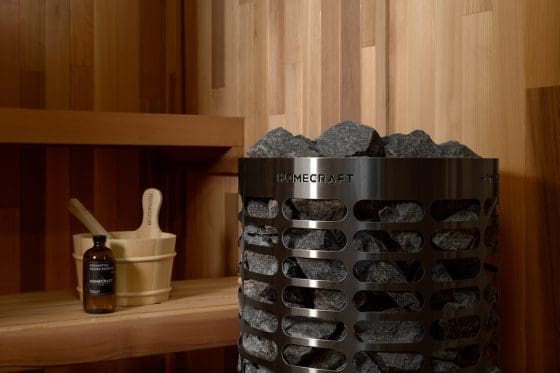
I’ve become particularly interested in their protected-element designs. The two primary heater families I’m working with are Homecraft Revive, the square design, and Homecraft Apex, the round design. Both are available in 6 kW, 7.5 kW, and 9 kW sizes. Shown here.
Rather than weaving heating elements directly through the rocks, these heaters protect the elements while allowing heat and airflow to move up through the rock chamber.
This gives us several things I like, protected heating elements, good airflow, hot stones, good rock capacity, serviceability, and strong löyly performance.
It’s a design philosophy that makes sense to me.
| Revive | Apex | |
|---|---|---|
| Shape | Square | Round |
| Heating elements | Protected | Protected |
| Available sizes | 6, 7.5, 9 kW | 6, 7.5, 9 kW |
| Rock capacity (9kW) | 200 lbs. approx. | 300 lbs. approx. |
| Footprint size | 14″ x 14″ | 18″ circumference |

9. Why I’m comfortable recommending them
A disclosure here is important. I embassador Homecraft heaters through SaunaTimes.
But I could shopping cart and sell all the major sauna heater brands. I’ve been to the factories. I’ve looked inside the heaters. I’ve talked with manufacturers. I’ve used most of them. And I’ve spent years trying to understand what actually makes a sauna heater perform well instead of simply repeating specifications from manufacturer brochures.
I didn’t start recommending Homecraft because I sell them. I sell them because I recommend them.
That doesn’t mean there aren’t other good electric sauna heaters. There absolutely are. Conventional electric sauna heaters have been making people smile for decades. It means that when I look at the fundamentals, element protection, airflow, rock heating, recovery, construction, value, and serviceability, I like what I see.
10. Don’t buy a sauna heater based on looks alone
This is probably the biggest change in the electric sauna heater market over the last decade. Heaters have become design objects, and that’s great. There are some beautiful electric sauna heaters available today.
But a sauna heater is more than a sculpture. It’s a machine, a thermal battery. Its job is to convert electricity into the kind of heat we want in sauna.
So before buying a heater because of how it looks great on Instagram, I’d ask a few questions. How are the elements arranged? How much rock mass is there? How effectively are those rocks heated? Can air move through the heater? What happens when I throw several ladles of water onto the stones? How quickly does it recover? How easy is it to replace an element? What happens after five or ten years of use?
Those questions tell us much more than the shape of the heater.
The goal is simple
When choosing an electric sauna heater, I keep coming back to the basics. We want:
- A properly sized heater
- Hot rocks
- Enough thermal mass to produce satisfying löyly
- Good rock recovery
- Air moving freely through the heater and through the sauna
- Heating elements that last
- Heavy grade materials
- Made from a company with great integrity.
Need help sizing your electric sauna heater?
We’d love to provide you with a new Homecraft heater: factory to your front door. Fill out a request for quote, which includes a simple request of your hot-room size, and the approximate amount of glass or other uninsulated surface area. We’ll help determine the appropriate heater size for your sauna and make sure buying the ideal size and configuration for your sauna.
I’m excited to help you find the right Homecraft heater for your sauna. For when we feel good heat, it’s all over (including your search for it).

*If water with essential oils reaches a red-hot electric sauna element directly, a few things can happen, and most aren’t good.
The water itself flashes to vapor quickly. The essential oil is different. It’s a mixture of volatile organic compounds, and on a very hot metal element those compounds can evaporate, thermally degrade, or burn rather than simply joining the steam coming off the stones. That can create a sharper, burnt or acrid smell instead of the aroma you intended.
Repeated exposure can also leave baked-on residue on the element and nearby metal. Depending on the oil, concentration, heater materials, and frequency of use, that residue and repeated wetting can contribute to fouling and potentially shorten component life. This is especially relevant in commercial saunas where people may use far too much oil.
We don’t want anything except the intended electrical/thermal environment directly on a heating element. Water and aromatic mixtures are better vaporized from hot sauna stones.
1 thought on “Electric Sauna Heaters: What to Know Before You Buy”
Great Story and one I will forward to a new public sauna nearby. It has a large sauna room with 2 electric heaters. The room gets very hot 200F but the rocks do not get very hot and do not create good loyly. The rocks are separate from the heating elements but if you put water on them it ends up as rock soup. I (along with some Slavic friends have been able to circumvent the lack of loyly by putting water on the cedar walls. This accomplishes 2 things. 1- raises the humidity in the sauna and gives a loyly feeling 2- give an amazing wood /cedar smell from the water on the cedar boards.