

A field guide to saunapreneurship—from drop-off rentals to public hot rooms, marginal thinking to spiritual sweat equity.
– Wade Litt, Ph.D.
So you want to start a mobile sauna business? That’s great! You, too, can live the easy, lucrative life of a saunapreneur. Slap a barrel sauna on a trailer for less than $10K, all in, and drop it off at a new party every weekend while you sit at home counting your money.
As you count, though, you realize that $500 a weekend for 50 weeks out of the year is just $25,000, and that’s before gas, firewood, taxes, scheduling software, and other costs. If this is going to be as lucrative as you wanted, you’re going to need a few more saunas!
The draw of sauna entrepreneurship is real, and it is reasonably accessible to the average person due to relatively low barriers to entry and the convenient facts that, outside of Finland, this is a nascent industry and mobile saunas are on wheels: both of which help circumvent pesky red tape. If you’re interested in “saunapreneurship,” this article aims to outline some of the economics of operating a mobile sauna. I will draw from training in economics; from my many dedicated sauna trips to Finland, England, Minnesota, and other sauna havens around the States and the world; and from some of the things I’ve learned starting and running LÖ-LU Sauna in Columbus, Ohio
For a small-scale sauna business, there are two main approaches most operators take: the drop-off model and the public sauna model, the latter sometimes colloquially known as the “butts-in-seats” model.
The Drop-Off Model
Described in this article’s introduction in perhaps the most bootstrapped possible, this model involves taking your mobile sauna to locations for private parties and business partnerships. Sometimes you or an employee might be there for the duration of the drop-off but commonly this is a drop-it-off, give them some instructions, pray they don’t burn it down or use it for a scandalous week-long bender, and return to pick it up on Monday morning.
In all seriousness, liability is a potential concern here. I checked with my agent: fortunately for you if you take this approach, the insurance premiums are likely no higher with this model than the Public Sauna model described below, and even if there’s a problem, your policy should cover your losses. Nonetheless, I rest easier knowing that I or my trained employees are stoking the fire and being present with and for the guests.
With one mobile sauna using this model, you can probably make a modest side income, but you’re not likely going to be putting in your two-week notice anytime soon. A very rough sampling of such companies around the US have rental rates of $400/day, $600/weekend, $1000/week. Winters will not be at 100% capacity, summers not even close. To make this model work, you likely need a small fleet of saunas to have deployed as often as possible, especially during peak season.
Synopsis:
This is a relatively low-cost entry into a mobile sauna business. Its operation is less labor intensive but requires more capacity to make the same amount of revenue as a public sauna. There’s a reason very few of these exist in the more mature Finnish sauna market. The US—and indeed most non-Finnish sauna markets—lack education about what good sauna can be: the drop-off model isn’t as effective in this regard as the public sauna model.
The Public Sauna Model
This model involves having at least a semi-permanent home for your mobile sauna and taking bookings for people to come to you rather than you going to them. Typically there is at least one employee on site to help with the flow of guests and keep the stoves going. Finding a partner location can be tricky, especially in cities where people are unfamiliar with sauna.
Some partner with breweries, gyms, yoga studios, or event spaces, although I think parks offer a lot of potential. Michigan Saunas partners with a state park beach in Traverse City and 612 Sauna Society partners with city parks around Minneapolis. Parks are ideal because they’re naturally social spaces and, if that’s where you’re set up, people would be going there specifically to sauna—not just to tack on a quick 20-minute session after a gym workout.
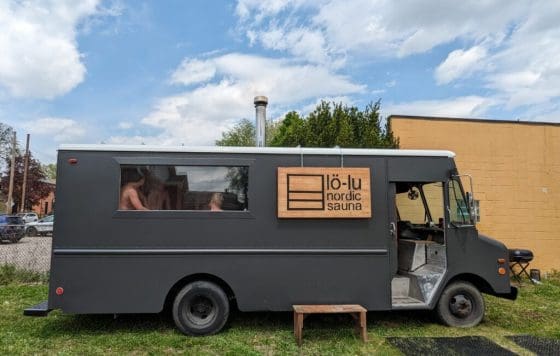
I had a bit of a chicken and egg problem when first starting in a city unfamiliar with social sauna. A local brewery was intrigued but uncertain—I was just a guy who built a sauna in the back of an old bread truck and I didn’t yet have much of a following. To build a following, though, I needed a home base to accept customers. In the end, I found my own property to house my sauna venture. It’s an unfinished garage and a small yard in a neighborhood that’s often overlooked because it’s too close to some rougher parts of town. It’s the perfect place, though, for a somewhat alternative idea like a public sauna and being a little more on the fringe made it much more affordable.
The garage serves as locker room, bathroom, escape from the cold, and mini workshop, and the yard houses the sauna, with plans for more, à la Community Sauna Baths in London or The Yard @ Superior Sauna in Minneapolis. Now that I have my own space and have built a following, I have gyms, yoga studios, and other organizations around the city reaching out to me instead of the other way around. Now, however, it doesn’t make as much business sense to leave my own space. If I do take the sauna around the city, which is extremely rare, I think about the lost revenue relative to staying on site as going into an advertising and awareness bucket.
A prime benefit of public sauna over the drop-off model is sauna education. People seem to appreciate hearing about sauna culture and history. I think it’s important to talk about throwing water on the rocks and approaching it as a social and relaxing activity rather than a health hack. With the public sauna model, I can do this for every customer; if I drop off a sauna for a birthday or bachelorette party, I might interact only with the host. Furthermore, my regulars can also help spread the good word to new guests while talking about sauna in the sauna! This educational component, I hope, will become a lesser issue as sauna culture continues to permeate the American market but for now, it’s a crucial component of a good sauna business.
One unexpected cost of having my own place instead of working with a partner location has been the time it takes to be my own landlord. Negotiating real estate deals, navigating city zoning and building codes, and fixing, say, frozen pipes in January myself rather than calling a landlord to take care of it: these small headaches add up. A partnership or lease allows you to outsource many of these headaches, but you’ll lose a bit of control and revenue.
I cautiously offer Löylykontti as an example of a Finnish company using this public sauna model without on-site staff during the sessions. The locker rooms and saunas are built in shipping containers, have keypad access where guests receive an individualized pin code upon booking, and they have electric stoves, requiring no labor costs for most of the day. I will say, the one I visited in Helsinki was rather underwhelming. I think it simply didn’t have an appropriately-sized heater for the space. Another downside of a model like this outside of Finland is, again, the inability to have someone on-site to help educate people about good sauna practice.
Synopsis:
With a good partner location, the barriers to entry with this model can be about as low as those for the drop-off model. With your own space you can capture a larger share of your revenue and design the space to your preferences. Although having yourself or an employee on-site comes at a cost, you ultimately can churn more people through the door per day, achieving much higher revenue potential than the drop-off model. Partnering, leasing, or owning your space is an important decision to consider, each with their own unique tradeoffs. This model is better suited for educating the public about sauna culture and good sauna practice and the direction I would love to see more mobile sauna businesses heading.
Thinking on the Margins
If you’re trying to maximize something, the general rule is to do it as long as the marginal cost of the next decision outweighs the marginal benefit, marginal being the next incremental unit. Suppose for example, you’ve got several boxes of cookies in front of you; how many do you eat? Should you eat the first one? The marginal cost of just this one is probably fairly small and it’s been a while since you’ve had a cookie, so that first cookie will give you a lot of benefit: eat it! Fast forward: now you’re nine cookies in and considering whether to eat the 10th. The marginal, or extra, benefit of one more cookie after you’ve already had ten is a lot lower than the pleasure you got from the first one, and the marginal cost is increasing right along with your waistline. Marginal benefits tend to diminish, and marginal costs tend to increase as we eat, make, build, and do more.
So what does marginal thinking have to do with sauna? Fortunately, sauna operators are in luck. Suppose you’ve got a ten-person sauna. The marginal cost of the first guest is mostly just however much firewood or electricity it takes to get your sauna hot and your own or your employee’s time. What’s the marginal cost of the 10th guest? Essentially zero! You may have minimal marginal costs for an extra tea bag or a small share of the sauna snacks they’ll eat, but the sauna is already hot and you’re paying for the labor regardless of whether there’s one person or ten.
Sauna is unlike, say, a restaurant where one more meal has another identical set of costs for the ingredients going into their meal, and more patrons will eventually require more waitstaff. At a sauna, however, one or two people are enough to keep stoves running for even dozens of people. In what other industries do we see zero-to-minimal marginal costs? Think digitally-oriented companies like Netflix: there are large, fixed costs to get up and running but the marginal operating cost of streaming a movie to the first viewer is nearly identical to the marginal cost for the 1000th viewer. It’s no surprise that the sauna companies that truly mean business with investors to keep happy and profits to maximize are the ones operating the 20, 50, even 90-person hot rooms. The sauna is already hot, the employees are already there, they’re going to have to clean the place at the end of the day regardless of the number of guests: every guest who enters after the first is gravy.
Keep marginal costs in mind when deciding on your scale—creating a larger capacity at startup is costly but a lot of potential. If you’re bootstrapping the company, you can always build more capacity later, but keep that in mind during the planning process. A couple potential considerations if you’re thinking about starting out with a large-capacity sauna from the start: larger saunas are less liquid than smaller ones should you ever want or need to sell. I’m happy to have a six-person sauna in my backyard, but a 20-person? Several smaller saunas offer the possibility for various temperatures or vibes; e.g., Community Sauna Baths in London has a dedicated “Silent Sauna.” I like the intimacy in smaller saunas and think they lead to great conversations – for any sauna but perhaps especially larger saunas, consider bench layout design if you want to try to facilitate such an environment.
Opportunity Costs Be Damned
I’ve been running my sauna only on weekends and without employees. I’m the sauna-builder, sauna host, webmaster, comptroller, plumber, gardener, content manager, and several other roles that would have their own employee in more established businesses. Don’t get me wrong—I’ve had a ton of help from friends, family, and neighbors, but this is hardly me practicing the “Specialize and Trade!” mantra that I’ve preached to thousands of students in Econ 101.
It may not be the most efficient or profit-maximizing strategy, but as long as it remains a side gig, the slower approach has offered valuable insights into business development and many opportunities to chat and sauna with my guests. Plus, building a business from the ground up and doing things yourself offers a certain spiritual quality and sense of meaning that isn’t easily substitutable. Opportunity costs be damned! (For anyone who can relate, I recommend reading “Shop Class as Soulcraft: An Inquiry into the Value of Work.”)
Many businesses have come to market much more quickly—if you can swing this or are okay with giving away a bit of equity to do so, that’s great: more sauna all around! Regardless of who is funding the project, though, I highly recommend—urge, even—that you spend a little time ahead of your initial build traveling around Finland for some dedicated sauna research. I believe this would do more for you than any sort of entrepreneurship course or consultations and probably at a lower cost. If you are looking for guidance on starting your business, most states have Small Business Development Centers (SBDCs) with free entrepreneurship courses, and the members within the sauna Facebook groups are a very helpful lot, even if sometimes militantly concerned about low bench heights!
Fire it up!
Entrepreneurship is not an easy path but can be extremely rewarding, especially something like a community-driven public sauna. Startup capital helps, to be sure, yet with relatively low barriers to entry and fewer regulations for things on wheels, it’s definitely possible to bootstrap a mobile sauna business. Ultimately, taking the plunge takes courage, and running it will demand more effort than you might expect, but—even for an economist—the rewards are hard to measure.
—
About the Author
Wade Litt is a Ph.D. economist who founded and runs LÖ-LU Sauna in Columbus, Ohio. He has written previously on SaunaTimes about mobile sauna chassis considerations, is active in the development of the North American Sauna Society (NASS) Sauna Ambassador program, has been interviewed on The Upper Bench sauna podcast, and recently hosted Finnish comedian Ismo at his sauna. He can be reached at wade@lo-lu.com.
1 thought on “So you want to start a mobile sauna business? ”
Well written! Why yes I am considering mobile sauna and I’m glad I read your work. I thought maybe I would do the mobile thing and drop it off… saves my weekends for 8 & 10 yr old soccer/volleyball/taekwondo… but at those returns what’s the point? In Wyoming I certainly won’t get 50 weekends of bookings (I might get 18… probably less). I would gain a better sauna than my basement IR (don’t tell Glenn) to park at my house and it would educate me significantly. Build the sauna first, do the mobile thing until the right location can be sourced. I especially appreciate the discussion on marginal cost, build the bigger one. Now I’m excited! Thanks for writing this!